
Company formation · WFOE · Legal support
Company Formation and Legal Support in China
Setting up a company in China is an important step for entrepreneurs and foreign businesses looking to develop their activities in the Chinese market. The choice of structure, location and administrative procedures should be adapted to the specific nature of each project.
For a foreign company, preparation does not stop once the business has been established. Trademark protection, patent registration, intellectual property and the security of commercial relationships should also be considered from the early stages of development.
SINOROADLINK helps coordinate the different stages of your project and facilitates access to qualified professionals when legal or regulatory expertise is required.
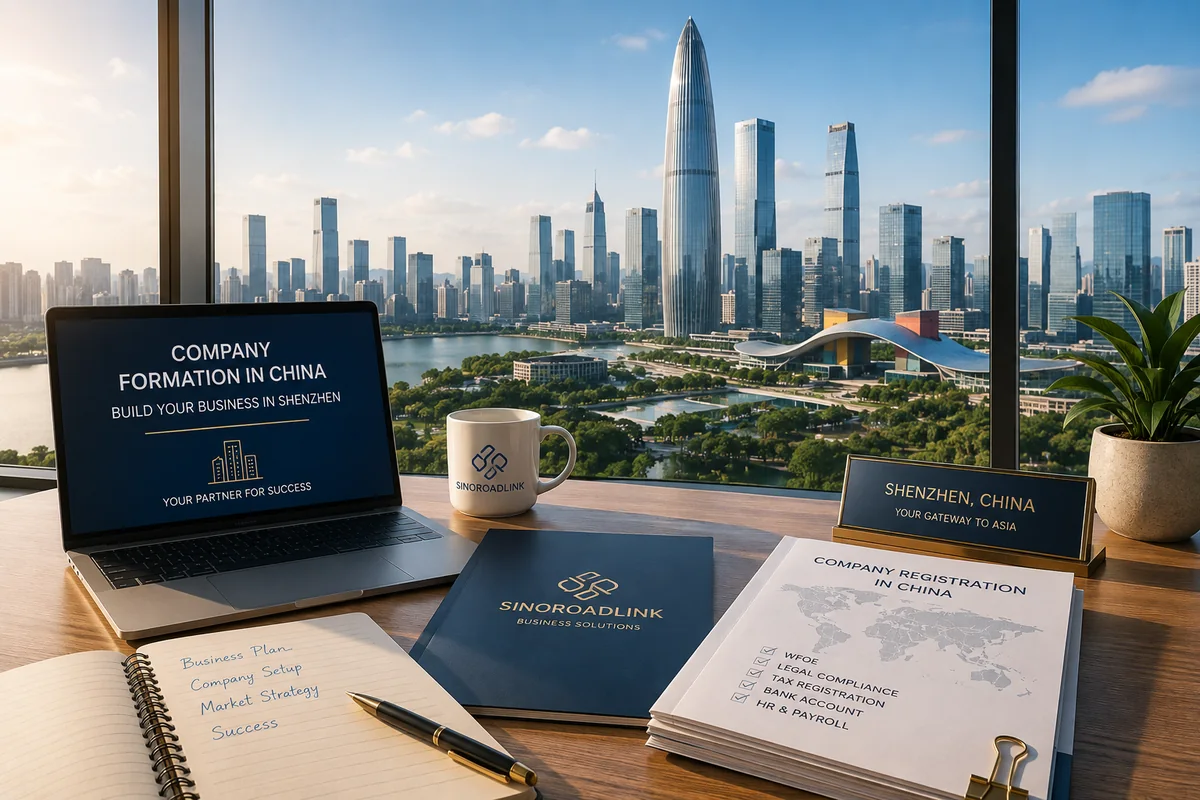
Company Formation in China
Building a structure adapted to your project
Before starting WFOE company formation in China, several factors should be considered, including the planned business activity, business model, location, operational requirements and development objectives, as well as the legal and compliance services required for the project.
This initial assessment helps identify the procedures to be completed and the relevant professionals or institutions involved.
Preparing the project in advance also makes it easier to anticipate documentation, administrative requirements and potential restrictions related to the proposed activity.
Before formalities begin, company registration in China should reflect the business activity, investors or shareholders, intended location and operational requirements.
WFOE: A Structure for Foreign Investors
A WFOE in China, or Wholly Foreign-Owned Enterprise, is a company established in China and owned by foreign investors.
This structure may be considered by businesses seeking a local presence and wishing to operate directly in the Chinese market.
Whether a WFOE is appropriate depends on the project, business activity and intended location. The applicable conditions require individual assessment under the official rules for foreign-invested companies in China.
Setting up a WFOE involves preparing the company’s information, compiling the required documentation and coordinating the various administrative procedures.
Depending on the project, other structures may also be considered to establish a presence in China.
| Structure | Principle | Best suited for |
|---|---|---|
| WFOE | 100% owned by one or more foreign investors | Trade, services or manufacturing depending on the authorised activity |
| Joint Venture | Capital shared with one or more Chinese partners | Projects requiring or favouring a local partner |
| Partnership | Several partners with responsibilities defined by the chosen structure | Collaborative projects between investors |
| Representative Office | Presence in China without directly carrying out profit-making activities | Market research, representation and business development |
Choosing Your Location in China
Finding the right location for your business
The choice of city is an important part of a China company formation project.
Depending on its commercial and operational objectives, a company may consider locations such as Shanghai, Shenzhen, Guangzhou, Foshan, Hainan or Yiwu.
Each location offers a different economic environment. The choice should therefore take into account the company’s activity, business partners, logistics requirements and long-term development plans.
Some procedures and requirements may also vary depending on the relevant jurisdiction. The appropriate process should therefore be established before administrative formalities begin.
The Steps Involved in Company Formation
Preparing the administrative process
The process of setting up a company in China may involve several stages depending on the structure and nature of the project:
- defining the business activity;
- selecting the appropriate structure;
- choosing the location;
- preparing the required information and documents;
- coordinating administrative procedures;
- communicating with the relevant parties;
- monitoring the progress of the application.
Preparing these elements in advance can help reduce errors and make the company registration process in China easier to manage.
Coordinating the different parties
For meetings with local partners, discover our business support and translation services in China.
When legal and compliance services are required, we facilitate contact with a qualified professional.
Trademark Protection in China
Protecting your name and brand identity
A trademark can become a valuable asset for a company developing its business in China.
A company name, logo or product brand should be identified early as an asset to protect.
Trademark protection in China can form an important part of a company’s intellectual property strategy and should be considered according to the territory in which the business intends to operate.
Planning your trademark registration
Planning trademark registration in China at an early stage helps assess the availability of the sign, the goods or services to be protected and the relevant territory before further investment is made in its commercial development.
The registration strategy should take into account the relevant goods and services as well as the territories where protection is required.
A trademark registered in another country does not automatically provide the same protection in China.
For official information, consult the resources provided by CNIPA — China National Intellectual Property Administration.

Patent Registration in China
Protecting an invention
A company developing an invention or technical solution may also consider patent registration in China.
The appropriate form of protection depends on the nature of the innovation and the company’s development strategy.
Depending on the project, different forms of industrial property protection may be considered, including invention patents, utility models and designs.
Building an intellectual property strategy
Intellectual property in China extends beyond trademarks and patents.
Depending on the business, it may also include:
- designs and models;
- product design;
- software and creative works;
- know-how;
- confidential information;
- technical or commercial information.
Identifying these assets at an early stage makes it easier to consider appropriate protection measures before information or technology is widely disclosed.
The WIPO — Intellectual Property Landscape: China resource provides further institutional information on intellectual property protection in China.
Securing Commercial Relationships
Contracts for international business
Creating a company is not the only legal consideration when establishing a business in China.
Relationships with suppliers, business partners, distributors and customers should also be properly structured.
For commercial contracts in China, the parties’ responsibilities, payment and delivery terms, acceptance criteria and the procedures to follow in the event of a dispute should be clearly defined.
When contract drafting or legal analysis requires specialist expertise, SINOROADLINK can facilitate contact with a lawyer or other qualified professional.
When a commercial relationship begins with a search for partners, our page on supplier sourcing in China explains the operational support available.
Anticipating commercial disputes
International business relationships can become complicated when the responsibilities and obligations of each party have not been clearly defined.
Establishing appropriate dispute resolution provisions can provide a clearer framework if disagreements arise.
This is particularly important when a company works with several partners operating under different legal jurisdictions.
Legal Assistance and Commercial Disputes in China
Working with a lawyer
A commercial dispute in China may involve a supplier, business partner, distributor, customer or another company.
When a situation requires legal analysis, consulting a lawyer in China may be necessary to assess the parties’ rights and determine the appropriate course of action.
The lawyer may review contracts, available documents, contractual obligations and other relevant elements before advising on the appropriate legal strategy.
Protecting your commercial interests
Legal difficulties may also involve intellectual property, such as unauthorised use of a trademark, reproduction of a design, exploitation of an invention or use of confidential information.
In such situations, the appropriate response depends on the rights held, the available evidence and the specific circumstances.
Depending on the matter, SINOROADLINK can facilitate contact with a commercial lawyer in China or another qualified legal professional.
Support for Structuring Your Business in China
From company formation to protection
Establishing a business in China can involve company formation, trademark and innovation protection, commercial contracts and, when necessary, dispute management. The aim is to maintain continuity between these stages as the business develops.
Key areas of support
Needs vary according to the chosen structure, location, assets to protect and commercial relationships to govern: company formation, trademark or patent protection, contracts and support if difficulties arise with a business partner.
SINOROADLINK
Structuring your business presence in China
Based in Shenzhen, SINOROADLINK offers entrepreneurs and foreign companies a local point of contact to structure their business presence in China.
This local presence facilitates operational follow-up and exchanges with the relevant parties in China.
Do you have a project in China?
Tell us about your business, your planned presence in China and your requirements.
We will help you organise the next steps according to your situation.
Present my projectSINOROADLINK is not a law firm and does not provide legal advice reserved for qualified legal professionals. When a matter requires it, we can facilitate coordination with lawyers or other qualified legal professionals in China.